A list of certified operators, suppliers, wholesalers, contract processors, non-organic ingredients, and much more, please refer to the Search Operators and Search Products section of the website, by clicking on the “Search” button at the top of this page.
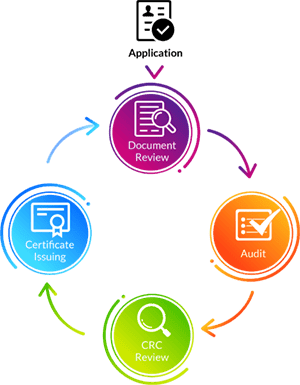
Starting your organic certification journey begins with a review of the applicable standards and subsequent application for certification with ACO.
ACO certifies to the National Standard for Organic and Biodynamic Production (NS) and the Australian Certified Organic Standard (ACOS) domestically in Australia.
If you are exporting organic product, you may require additional certification to regulated market standards such NOP (USA), Korea, Freshcare, JAS (JAPAN)or EU (European Union) Standards.
Application Process – Step by Step:
- Information – Contact us via Apply Now to express your interest for applying for certification. Upon receival of an expression of interest, ACO will provide you an information kit containing resources to be reviewed and documents required to be completed to commence the certification process.
Feel free to give us a call if you would like to talk through the process with our team of certification experts. - Eligibility for Application – ACO offers certification for the scopes and standards we offer within the regions which we operate in.
Operators are encouraged to pre-review their eligibility for the relevant certification schemes prior to application.
Primary producers should review their eligibility for certification to ensure land has been free of prohibited input applications for at least 3 years including allowance of a minimum of 1 year “In Conversion” period subject to soil testing results. During the in-conversion period you will have access to In Conversion Logos and a Certificate that states this, so your customers know that you are in the process and soon-to-be Certified. - Application – Our assessment of your application will begin once the documents within the information kit have been completed and submitted to ACO along with the application fee. This includes signing a certification agreement with ACO Certification Ltd which clearly states the rules and processes that the operator must abide by, including confidentiality requirements for both parties , including confidentiality requirements for both parties.
A certification officer will conduct a document review of the information provided and assess eligibility for certification. As part of this process, we may request further information or clarity or raise Corrective Action Requests (CARs) where practices that do not align with the standards are identified.
ACO may deny certification of an application if the application is ineligible for certification or cannot address CARs required to be in compliance with the standard requirements. Applicants will be formally notified of the reasons for denial and, where applicable, may reapply once the identified issues have been adequately addressed.
The timeline from receiving your applications to you receiving Certification is approximately a 10 week period. - Audit – Once the review of your application is completed an auditor will be allocated to visit your site and review practices in line with the standard requirements. It is important that audit inspections occur on site with the relevant key personnel of the business. The auditor may also collect samples for testing during the inspection to be tested at an accredited laboratory. Upon completion of the inspection, the auditor will provide ACO with a report of the inspection including any findings of concern.
- Review – Upon receival of the completed report form your auditor, the ACO certification team will review the audit report along with any sample test results to make a decision of granting / extending certification. We may raise Corrective Action Requests (CARs) or identify Opportunities for Improvement based on your inspection that will require addressing or rebuttal by the due date as applicable.
- Issuance of Certification– Once any applicable Corrective Action Requests (CARs) from the audit are resolved, ACO will issue an organic certificate to confirm certification. You may label and sell product as organic or in-conversion (as applicable) once your certification has been granted.
- Label Approvals – Once certified, you will have access to use and label product with logos applicable to the standards and scopes you are certified to. It’s important that any labels using the logo’s or referencing ACO are approved by ACO prior to printing. You can submit your labels for assessment via ACO’s Service Desk platform.
- Product Approvals – As your business grows, you may be adding crops or products to your certificate. You can do this at any stage throughout your certification by submitting a product approval application to the Service Desk platform. The recipes/procedures will then be reviewed by our Certification Team and added to your Certificate.
- Continuing your Certification
Ongoing Audit Requirements
Most schemes require annual onsite audits and unannounced audits for continuation of certification. ACO will conduct annual audits and unannounced audits where required to maintain certification.
You should have an audit at least 8 weeks prior to the expiry date on your current certificate.
Our Audit Co-Ordinator will schedule and allocate your audit according to area and services/programs you are certified to. An audit notification letter will be sent to you detailing all relevant details and information, including the details of the auditor conducting your on-site audit.
Once the audit is completed, a review process will occur as per step 5 above and an updated certificate with an extended expiry will be issued upon payment of fees.
Notification of Changes
It is important that you inform ACO of any significant changes to your business to ensure continued certification. Notifiable changes include but are not limited to the following.
– Changes to business structure or ownership
– Changes to approved practices, products/ scopes, audited facilities or land areas
– Changes to key personnel managing organics
Certain standards such as NOP, Korea and JAS certification requires an annual review of your business process and procedures; when your audit is allocated you will receive notice that you are due to provide ACO with an Annual Organic Integrity Plan Update to identify any changes in the business. This will be done yearly prior to your audit.
These plans/documents will be reviewed by one of our Certification Officers and assessed according to the certified standards.
Changes to Scope
Once certified, you can also extend the scope of your certification at any time by submitting an additional application to ACO. This includes:
– Additional properties or land.
– Additional facilities.
– Additional certification scopes, e.g., processing.
– Additional standards.
In most cases, an additional audit covering the new elements will be required. Depending on timing, this can be combined with your regular annual audit. Please ensure that you notify ACO before your annual audit if you wish to extend the scope of your certification, so that the new elements can be included in the audit. Please contact client.services@aco.net.au for more information about extending the scope of your certification.
You may also choose to withdraw or reduce your scope of certification where required by informing ACO in writing and completing a withdrawal form (available upon request from ACO). Please note that withdrawing or reducing your certification scope may affect your ability to continue selling product as organic in some cases as such we recommend discussing this with ACO prior to commencing withdrawal or reduction of certification / scope.
Corrective Actions Requests Process:
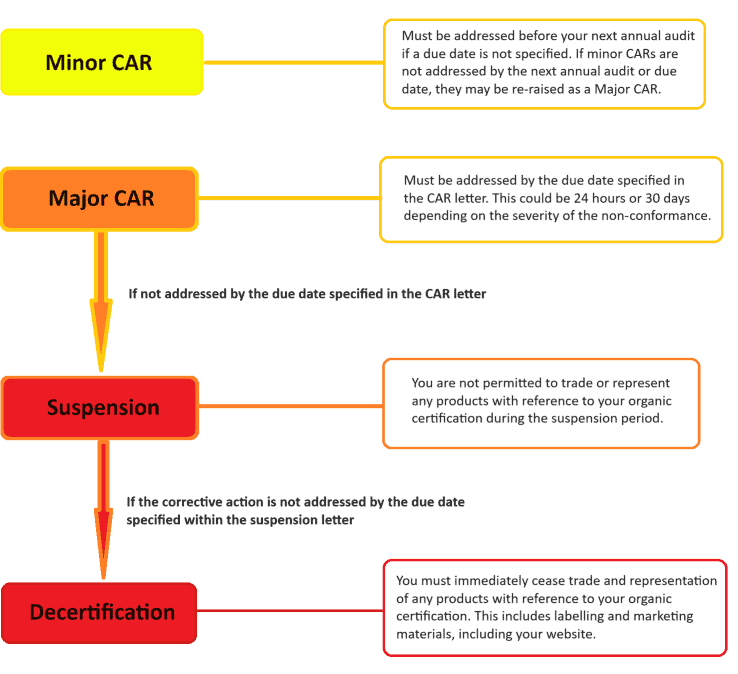
This corrective action process applies to organic standards excluding USDA NOP. Please refer to NonCompliance and Adverse Action Chart for the USDA NOP corrective action process.
It’s important to keep on top of any non-conformances raised so you can continue to trade as certified organic.
Corrective Actions Requests (CARs) may be raised when a non-conformance to the standards is identified as part of your audit, routine surveillance, due to complaints or residue detections. When a CAR is raised, it will have a due date assigned. If these CARs are not addressed by the due date specified in the CAR letter, your operation may face the Suspension Process.
*Please note, the suspension processes for certain standards may vary. Please contact the ACO office if you have any standard specific questions.
You have the right to appeal all decisions made by ACO. The appeal process is based on an application by you in writing to the Appeals Committee within 30 days of receipt of the certification decision. You can do this via the Contact Tab.
 English
  Chinese
  Thai
Thai  English
  Chinese
 Thai
Thai